GLM-5.4: Z.ai Takes AI Coding Beyond Traditional Software
Z.ai says its new flagship model can use code as a route into video, games and 3D design—not just software. The notable change is how it tries to get more reasoning depth from a fixed set of model weights.
Short answer: GLM-5.4 is Z.ai’s latest flagship AI model, announced on 23 November 2026. It uses a Loop Transformer design that runs shared layers more than once, adds vision, and targets tasks built through code—including video, games, 3D scenes and mechanical design. Access is rolling out through Z.ai’s coding products.
What is different about GLM-5.4’s architecture?
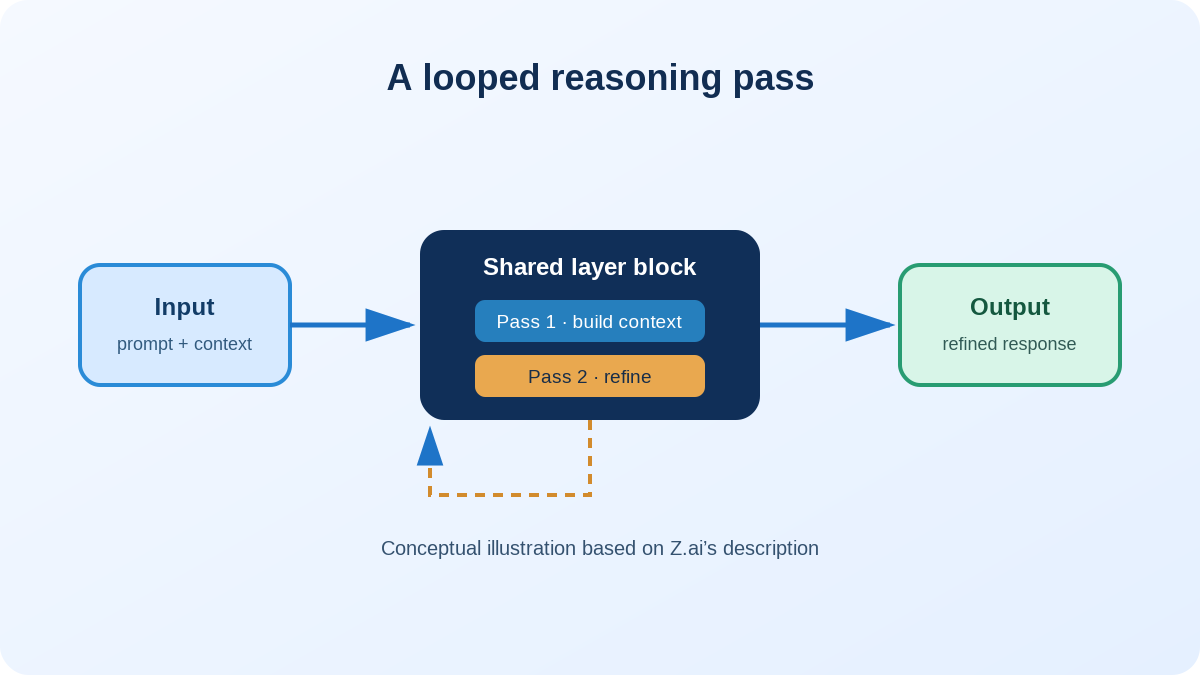
The headline change is the Loop Transformer. In a conventional transformer, each layer processes the hidden representation once during a forward pass. Z.ai says GLM-5.4 reuses 28 layers from its GLM-5 base model for two iterations. The second pass refines the representation created by the first, adding computational depth without adding another full set of parameters.
Reusing layers is one way to spend more compute on difficult reasoning without simply making a model wider. It also creates engineering challenges. Z.ai describes per-token gates that control how much each iteration updates the representation, along with changes to key-value caching and sparse-attention index reuse intended to limit memory and serving overhead.
What can people use it for beyond writing code?
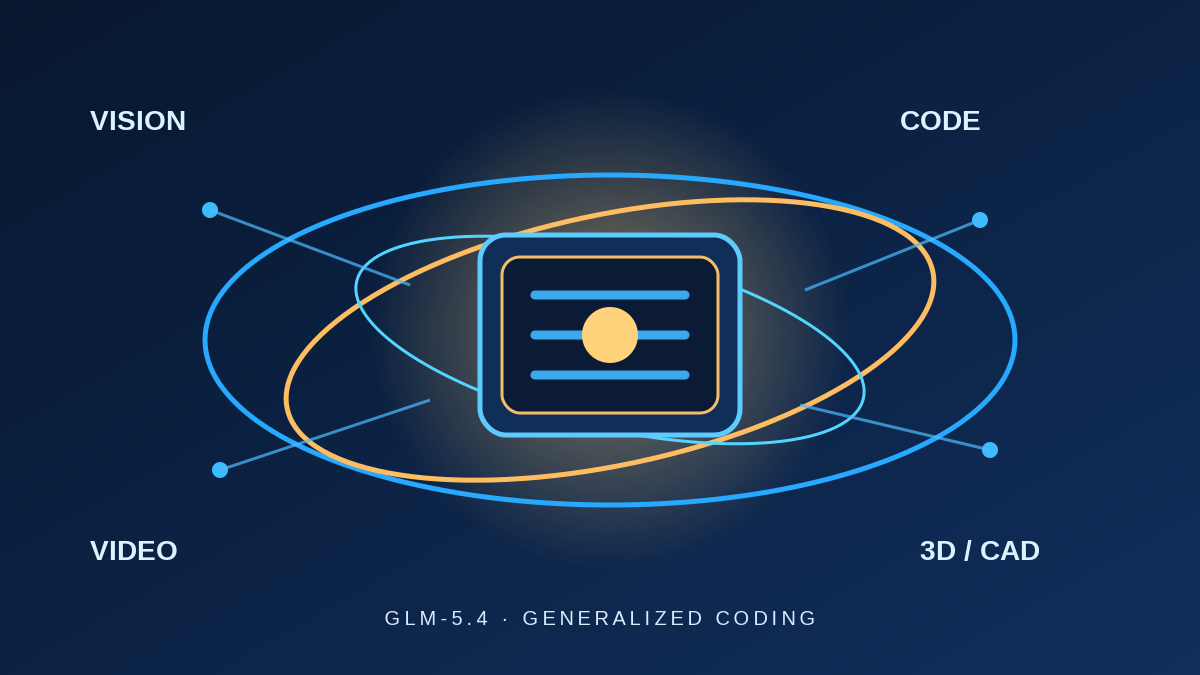
Z.ai calls the direction “Generalized Coding”: using code as a flexible way to create or control other kinds of digital work. Its launch examples include generating and editing video, building a complete game, producing 3D scenes with custom shaders, and creating mechanical designs in CAD software.
For a developer, that could mean asking a model to write the code behind an interactive prototype rather than stopping at a text answer. For a designer or engineer, it suggests a workflow where the model helps create a structured artifact that can be inspected and changed. These are company demonstrations, not a promise that every complex project will work unattended.
GLM-5.4 also adds vision, making visual input part of its coding-oriented workflow. Z.ai reports a one-million-token context window and generation speeds of up to 200 tokens per second off-peak and around 70–80 at peak. These are vendor-reported figures; actual speed depends on workload and service conditions.
Where can you try GLM-5.4 today?
Z.ai points users to its GLM Coding Plan, ZCode and Z.ai Chat. ZCode’s version 4.0.0 release notes, dated 23 November, list GLM-5.4 as available on the Coding Plan and preconfigured in the product. ZCode’s documentation explains how to connect a Coding Plan or configure an API key.
There are two caveats. The launch post marks the general model API as “Coming Soon”, so do not assume a public API is ready for every account. Z.ai also says it plans to release open weights only after safety hardening. This is not yet a model download that you can simply run on your own hardware.
How should you read the performance claims?
Z.ai says GLM-5.4 reaches intelligence levels comparable to models with two to three trillion parameters. That is the company’s claim, not an independently established result in the launch material. The post also describes an internal comparison on a 30-billion-parameter model, where a looped version improved on several reasoning benchmarks with roughly 10% more training compute. That is useful technical context, but it is not an independent evaluation of the 750-billion-parameter flagship.
The company acknowledges a limitation: GLM-5.4 can get caught in long “marathon thinking” loops. Longer reflection may help difficult tasks, but it can also mean waiting longer or using more compute. For everyday work, the meaningful test is whether the model completes your task accurately, quickly and at a cost you can accept.
What should teams do next?
If you already use Z.ai’s coding tools, test GLM-5.4 on a small, representative task: inspect a codebase, generate a visual prototype, or turn a design brief into a simple 3D artifact. Compare the output with your current model and record how much correction it needs. Keep human review for code, CAD dimensions, security-sensitive changes and anything shipped to customers.
If you are evaluating AI integrations more broadly, review the permissions you grant. Our plain-English guide to MCP connectors explains why it matters to check what an assistant can read or change before connecting it to work systems.
Bottom line: GLM-5.4 is notable for combining a looped reasoning architecture with a wider ambition for code-driven creation. It is worth testing for developers and technical creators, but the strongest comparisons remain vendor claims and some access paths are still pending.
What else should you know about GLM-5.4?
What is GLM-5.4?
GLM-5.4 is Z.ai’s flagship model built around a Loop Transformer architecture. It adds vision and targets coding-led work such as video, games, 3D and CAD.
Can I use GLM-5.4 today?
Z.ai says it is available through its Coding Plan and ZCode. The general API is marked as coming soon, and open weights are planned after safety hardening.
Are the 2T–3T model comparisons independently verified?
No independent verification is cited in the launch announcement. Treat the comparison as Z.ai’s own claim, not an established benchmark result.